Codependency vs Interdependence: Know the Difference
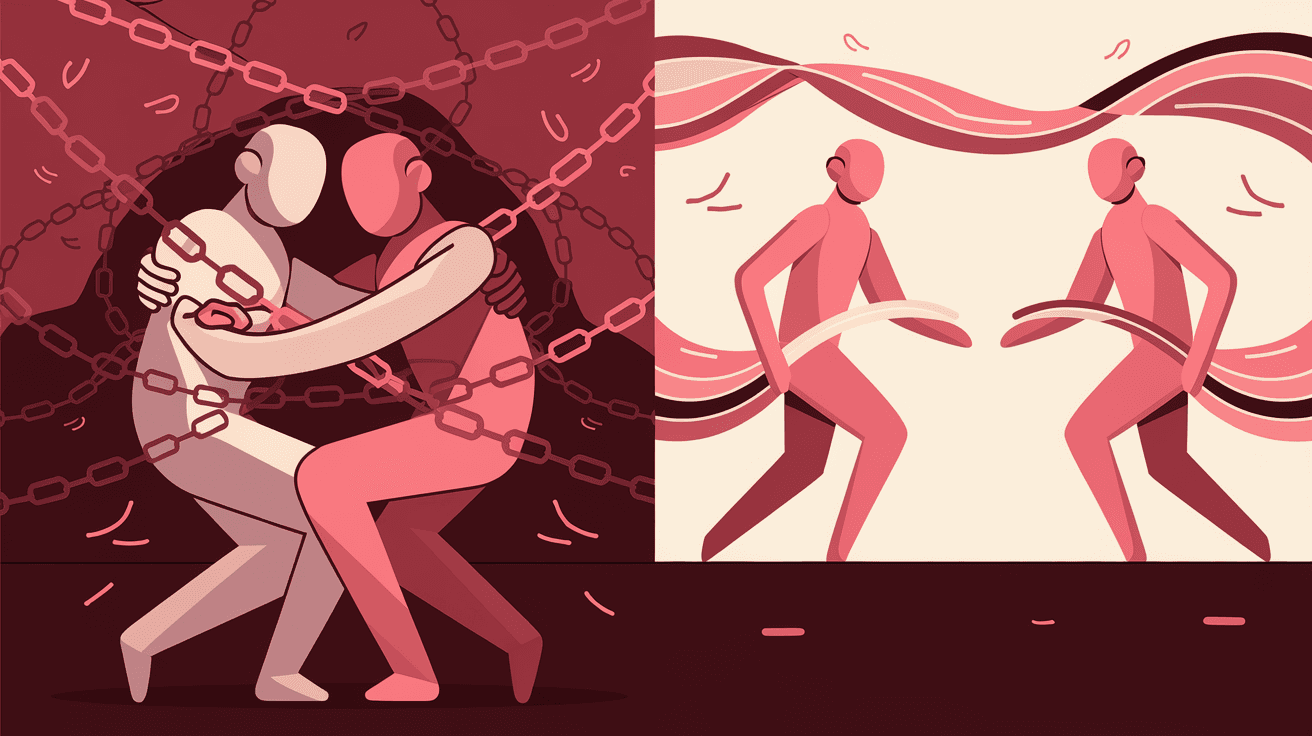
You can love someone completely without losing yourself—but most people never learn the difference between healthy connection and emotional fusion.
Most relationship advice treats all dependency as unhealthy, leaving people confused about when connection becomes codependency. The result? Either anxious attachment that suffocates relationships or avoidant patterns that prevent real intimacy. Understanding the distinction between codependency and interdependence isn't just relationship advice—it's the foundation of emotional maturity.
The Connection-Autonomy Framework: Mapping Healthy vs. Unhealthy Dependence
Why This Framework Works
The human brain is wired for both connection and autonomy—two drives that seem contradictory but are actually complementary. Research by Dr. Edward Deci and Richard Ryan on Self-Determination Theory shows that psychological well-being requires three core needs: autonomy (feeling volitional), competence (feeling effective), and relatedness (feeling connected).
The problem isn't dependence itself—it's how we depend on others. Codependency violates autonomy while interdependence preserves it. This framework helps you identify which type of dependence you're experiencing and course-correct before patterns become entrenched.
The Four Dimensions of Dependence
1. Identity Integration vs. Identity Fusion
Codependent Pattern (Identity Fusion):
- Your sense of self fluctuates based on your partner's mood
- You can't articulate your preferences when they differ from your partner's
- You feel guilty for having needs that might inconvenience others
- Your self-worth depends on being needed
- You maintain consistent values regardless of relationship dynamics
- You can hold space for your partner's emotions without absorbing them
- You express needs clearly while respecting others' boundaries
- Your self-worth comes from internal sources, enhanced by (not dependent on) relationships
2. Emotional Regulation vs. Emotional Outsourcing
Codependent Pattern (Emotional Outsourcing):
- You feel responsible for managing others' emotions
- Your emotional state mirrors your partner's automatically
- You avoid conflict even when boundaries are violated
- You use relationships to escape uncomfortable feelings
- You can be present for others' pain without fixing it
- You experience empathy without emotional contagion
- You address conflict directly while staying emotionally regulated
- You process difficult emotions independently, then share insights
3. Reciprocal Support vs. Unbalanced Caretaking
Codependent Pattern (Unbalanced Caretaking):
- Giving feels mandatory; receiving feels uncomfortable
- You anticipate needs before they're expressed
- You feel resentful but can't stop over-giving
- You attract people who need "fixing"
- Support flows both ways based on current capacity
- You ask directly for what you need
- You can receive help without guilt or debt
- You're attracted to people who are already whole
4. Flexible Boundaries vs. Merged Boundaries
Codependent Pattern (Merged Boundaries):
- You feel guilty saying no to reasonable requests
- Others' problems become your emergencies
- You share personal information to create artificial intimacy
- Physical space feels threatening to the relationship
- You can be close without losing your separateness
- You maintain individual friendships and interests
- You share vulnerably while respecting privacy
- You can be alone without feeling abandoned
Application Guide
Step 1: Diagnostic Assessment (Week 1)
Track your responses to these situations for one week:- Partner comes home stressed
- Friend asks for a favor during your personal time
- Someone criticizes your decision
- You have a need that might inconvenience someone
Step 2: Pattern Identification (Week 2)
Identify your top two codependent patterns using the four dimensions above. Most people have one primary pattern and one secondary.Common combinations:
- Identity Fusion + Emotional Outsourcing = "The Mood Mirror"
- Unbalanced Caretaking + Merged Boundaries = "The Over-Giver"
- Emotional Outsourcing + Unbalanced Caretaking = "The Fixer"
Step 3: Boundary Experiments (Weeks 3-4)
Start with low-stakes situations. Practice these micro-boundaries:- Take 10 seconds before responding to requests
- Use "I" statements instead of "we" when expressing preferences
- Sit with someone's disappointment without immediately fixing it
- Schedule alone time without justifying it
Step 4: Integration Practice (Ongoing)
Develop interdependent responses:- Before reacting: "Is this my emotion or theirs?"
- Before giving: "Am I giving from abundance or depletion?"
- Before agreeing: "Does this align with my values?"
- Before fixing: "Did they ask for solutions or just support?"
Example Application
Scenario: Your partner had a terrible day at work and is venting angrily about their boss.
Codependent Response:
- Immediately feel anxious about their mood
- Offer multiple solutions they didn't request
- Feel responsible for cheering them up
- Cancel your evening plans to stay home
- Listen actively without absorbing their emotion
- Ask "Do you want solutions or just someone to hear you?"
- Validate their experience without taking it on
- Maintain your evening plans while offering connection first
Common Mistakes
Mistake 1: Confusing Independence with Interdependence
Independence says "I don't need anyone." Interdependence says "I'm whole on my own AND I choose connection." True interdependence requires the capacity for independence.Mistake 2: Using Boundaries as Walls
Healthy boundaries are permeable—they protect without isolating. If you find yourself cutting people off rather than communicating limits, you've swung too far toward avoidance.Mistake 3: Expecting Immediate Comfort
Codependent patterns feel familiar because they're learned early. Interdependence might feel "cold" or "selfish" initially. This discomfort is growth, not evidence you're doing it wrong.Mistake 4: Binary Thinking
You don't flip a switch from codependent to interdependent. Most people oscillate between patterns depending on stress levels, relationship dynamics, and personal capacity. Progress isn't perfection—it's awareness.Mistake 5: Trying to Change Others
You cannot make someone else interdependent. Focus on your own patterns. Paradoxically, your emotional health often inspires others to examine their own patterns.The Neuroscience of Change
Research by Dr. Dan Siegel shows that secure attachment patterns can be developed at any age through "earned security"—consciously practiced emotional regulation and boundary-setting. The brain's neuroplasticity means codependent patterns, while deeply grooved, are not permanent.
A 2019 study by Perera et al. found that individuals who practiced mindful awareness of their emotional boundaries showed measurable changes in brain regions associated with self-regulation within 8 weeks.
Warning Signs You're Backsliding
- Feeling guilty for having needs
- Automatic "yes" responses to requests
- Physical tension when others are upset
- Difficulty accessing your own preferences
- Resentment building without clear communication
Key Takeaways
- 1.Codependency sacrifices self for relationship; interdependence enhances both
- 2.Healthy dependence preserves individual identity while fostering connection
- 3.The goal isn't emotional independence—it's conscious choice in how you connect
- 4.Change happens through practice, not insight alone
Your Primary Action
For the next week, before responding to any request or emotional situation, pause and ask: "Am I responding from fear or choice?" This single question begins rewiring codependent patterns toward interdependent ones.
Related Articles
Did you find this article helpful?
Comments
Get More Like This
Weekly evidence-based insights on Mind, Body, Heart, Wealth, and Spirit. No spam—just actionable frameworks.
The Catalyst Newsletter
Weekly research, investigations, and free tools. No sponsors, no fluff. Unsubscribe anytime.
Ready to take action?
Get personalized insights and track your progress across all five dimensions with The Mirror.
Access The Mirror